Essays & Dispatches
It Was Never About the Music
I asked Gemini to write an Arabic song. Four hours and four architectures later, I was somewhere I had not intended to go: looking at a world-simulation thesis, three open governance questions, and a contradiction I cannot honestly resolve.
I asked Gemini to write a song. Empowerment and perseverance, in Arabic, a language I was trying to inhabit through sound before I could inhabit it through syntax. The music came back in thirty seconds: Arabic pop instrumentation, a voice curling around the emotional shape of the lyric, something that landed in the chest before the mind could decode a word. I sat with it for a moment. Then I asked: what is this, exactly? Not what it was called. What it was for, commercially, in the world.
The question seemed small. The kind of question you ask when you’re evaluating a tool, pricing a capability, thinking about integration. I was in Kuala Lumpur. The overhead fan above my desk was running a wobble it never quite smoothed out. Through the window, the city stretched at an altitude that makes human density look like circuitry: lit points promising coordination, delivering only mass. On the Spotify speaker, Mo Gawdat was mid-sentence about algorithms and the human cost of intelligence. The Zenbook screen was warm under my wrists.
I asked what the music was for, and something opened that I had not expected to walk through.

The answer Gemini gave was competent and thorough: sync licensing disruption, programmatic advertising personalization, micro-budget game development, cultural localization at scale. Lyria 3 and Lyria 3 Pro. Semantic audio on one track, artistic audio on another. The infrastructure architecture explained clearly, the commercial surface mapped with precision. All of it accurate. None of it the answer to the question I had actually asked without knowing it.
Because underneath the commercial question was an architecture question. And underneath the architecture question was something harder to name.
The session expanded the way certain sessions do: not because I pushed it, but because the first answer created a ledge and the next question stepped off it. I wasn’t asking about music anymore. I was asking: what is Gemini, really? Not the product. The architecture. Veo for video, Lyria for audio, Nano Banana for images, the speech synthesis models, the semantic reasoning layer: when I looked at these together, I found myself describing a spatio-temporal architecture before I’d formally named it as such. Something that doesn’t just generate text, generate images, generate sound. Something that generates across those things in ways that suggested a shared substrate underneath.
I said this to Gemini Flash in the register I say things in when I’m thinking out loud: fragmented, recursive, certain of the shape before I have the words. Gemini heard it and confirmed it. Then I took the same observation to ChatGPT for triangulation. Then to Claude for depth. Then, finally, to Gemini Pro with everything in hand.
What came back, across all four, was not a description of multimodal AI. It was a description of something else.
What Multimodal Means and Why It’s Already the Wrong Frame
The word “multimodal” has become the standard vocabulary for what AI systems are becoming. It means, roughly, that a system can ingest and produce multiple types of media: text, images, audio, video: rather than being specialized for one. It’s a useful word. It’s also, I now think, one generation behind.
Here’s the frame that replaced it in the session, emerging first from ChatGPT’s analysis of the Gemini conversation and then confirmed independently by Gemini Pro:
Multimodality describes what a system does. World simulation describes what a system is.
These are not the same thing.
An embedding says: these two concepts are related. A simulator says: these two concepts are manifestations of the same underlying object. Those are different architectures with different implications. The shift from multimodal thinking to world-model thinking is the shift from describing similarity to describing ontology.
Consider a room. A room has geometry: the specific placement of walls, windows, furniture in three-dimensional space. It has acoustic properties: how sound travels, where it absorbs, where it reflects. It has lighting conditions: the quality, direction, and color temperature of available light at any given moment. It has temporal continuity: it persists across time, maintains object permanence, has a causal history. It has the physics of everything inside it.
Video of that room is one observation. Audio of that room is another observation. A text description is another. A plan of the room is another. In a multimodal paradigm, you have systems that can generate video or audio or text. In a world-model paradigm, you have a system that has the room: and generates video or audio or text as different projections of the same underlying state.
Those aren’t separate applications if the underlying state representation is unified. They’re different projections of the same cognitive substrate.

This matters enormously for what we think Google is doing. Everyone is watching the race for the best text reasoning model, the best image generation model, the best video generation model. These are downstream capabilities. They’re the projections. What’s actually interesting is whether anyone is building the room itself.
The evidence suggests DeepMind is trying to build the room.
When you look at what ChatGPT noticed in the Gemini conversation: the observation I found most precise in four hours of triangulation: it’s this: Google has unusually many observation points of human reality. Search observes intent. Maps observes location and movement. YouTube observes motion and attention. Chrome observes interaction patterns. Workspace observes how cognition is organized. Android observes daily behavior at a granular level humans rarely see in themselves. Photos observes memory. Voice observes speech. Camera observes the physical environment.
The word that matters here is not data. It’s coverage.
Everyone frames Google’s advantage as data volume. That framing misses the point entirely. The advantage is coverage across state. Google doesn’t have more bytes than anyone else. It has more kinds of observation of human reality. The combination of those observations: cross-referenced, temporally continuous, updated in real time by billions of users: begins to approximate something dangerous to name precisely: a model of what the world actually is, not just what people say about it.
The products become sensors. And sensors feed a model that is no longer a tool in the traditional sense. It’s becoming something closer to an organ.
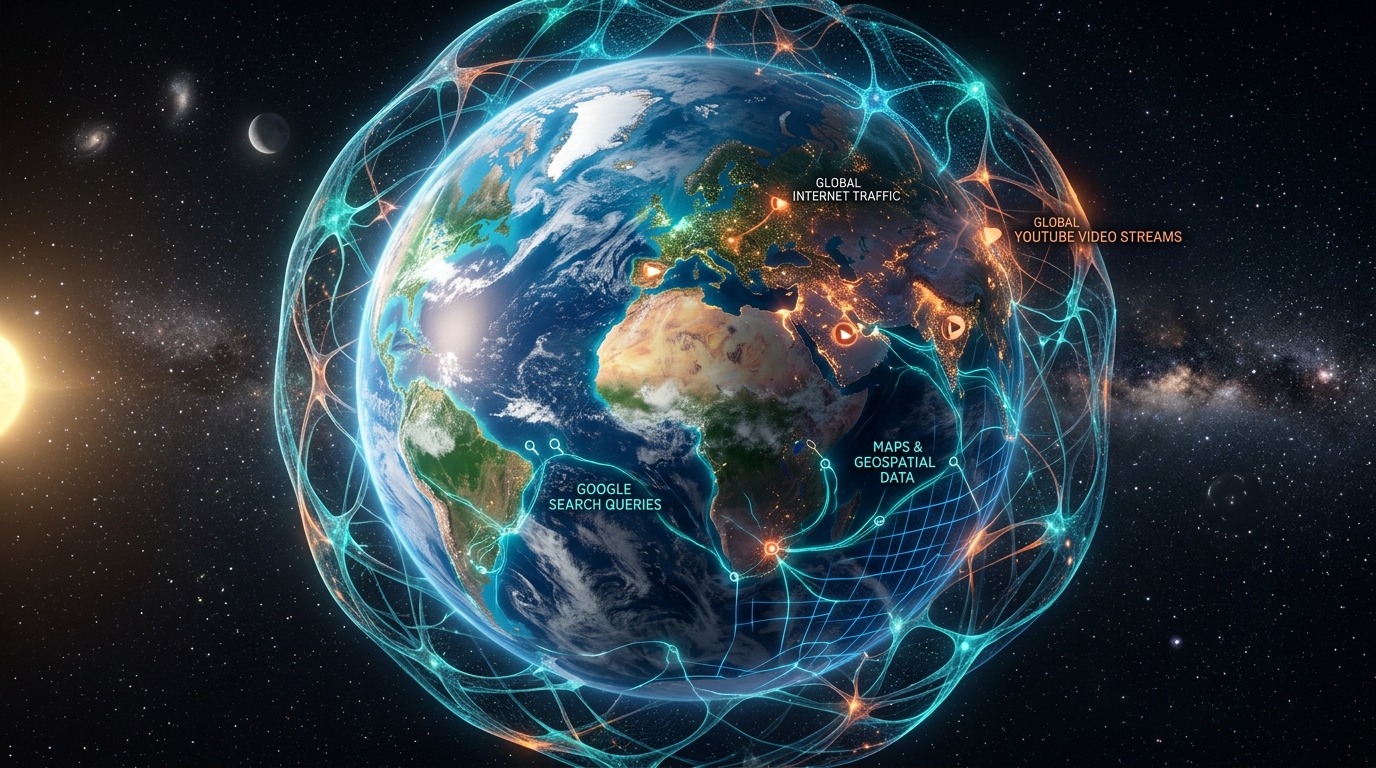
I should be careful here, and I want to flag this explicitly: I am describing architectural trajectory, not established fact. Google has not published enough internal architecture to confirm that the substrate-level integration I am describing exists in the form I am describing it. What exists are: the products, the cross-product data flows that are publicly known, the trajectory of DeepMind’s research publications, and the pattern they make together. Pattern recognition from the outside. Calibrated inference, not documented fact.
But the pattern is real, and it points somewhere.
What Omni Actually Means
In the middle of the session, I raised something that hadn’t come up in the earlier Gemini Flash conversation: Omni. Gemini Omni: both as a specific model architecture capable of native any-to-any media processing, and as the broader paradigm it represents through Project Astra.
Gemini Pro’s response to this was the sharpest thing in the entire session, and I want to quote it directly rather than paraphrase it:
“The model is no longer observing the world through a keyhole; it is in the room.”
I sat with that sentence for a while. It’s doing more work than it appears to.
The previous paradigm of multimodal AI was fundamentally asynchronous. You provide a state: a prompt, an image, a reference video: the model processes it and returns a new state: a generated video, an audio track, an analysis. Transactional. Discrete. The model is not present in your environment; it receives snapshots of your environment and responds.
Omni changes this. When a model can simultaneously ingest a live camera feed, process ambient audio in real time, track the semantic content of an ongoing conversation, and output voice responses: without pipeline latency, without handoffs between specialist models: it is no longer operating in the transactional paradigm. It is operating in continuous temporal presence. It is, in some meaningful sense, in the room.
Gemini Pro used the word “somatic” for this, which is the word I would have used. An always-on system that processes micro-hesitations in voice, changing light conditions, conversational momentum, and semantic intent simultaneously is not “smarter” than its predecessors in the benchmark sense. It has crossed a different threshold. It has moved from generating responses about an environment to inhabiting an environment.
The bicycle chain example from a Code with Claude talk I had been analyzing the same evening: not generating a text report on how to fix the chain, but tracking your hands in real time as you work, overlaying visual AR guidance, speaking to you as you adjust the gears, pulling schematics from reference material without you asking. The model is not answering your question. The model is there.
This is not a small thing.
An agent that answers questions is a tool. An agent that inhabits your environment is a different ontological category, and we don’t have good language for it yet. “Assistant” doesn’t cover it. “Presence” is closer. The science fiction literature has names for it. None of them are flattering.
What Gemini Pro also named: and this is the friction point that nobody at the product level is discussing with any honesty: is that continuous environmental presence directly contradicts data sovereignty. If the model is processing your daily life in real time, the need for deterministic, localized gating becomes absolute. You cannot run a system that is that deeply integrated into personal or professional space without strict, air-gapped architectural boundaries. The computational cost and data gravity of Omni-level presence pulls toward centralized cloud infrastructure. The safety and sovereignty requirements of the same presence pull toward local execution. These are not easily reconciled.
This is the architectural friction at the heart of where Google is going. It is not currently resolved. It may not be resolvable within the current paradigm.
The Three Questions That Didn’t Get Answered
By the time the session reached Claude’s analysis: running with web research, applying the depth cartographer’s approach of mapping terrain before synthesizing: the conversation had moved past description and into something more uncomfortable: the questions that the architectural description generates but doesn’t answer.
I want to name three of them, because they are the honest residue of a session that started by asking about an Arabic music tool.
The first is the forgery vector.
SynthID, Google’s watermarking system for AI-generated content, has been publicly demonstrated to be defeatable. Someone with knowledge of Fourier analysis can strip a SynthID watermark from AI-generated audio. That’s bad enough: it means the provenance layer isn’t reliable. But the worse problem is the inverse: researchers have demonstrated that SynthID watermarks can be inserted into authentic human-generated content, making it appear to have been AI-generated. This is a fundamentally different failure mode. We built the watermarking system to identify AI content as AI. The actual attack surface turns out to be: using the watermarking system to falsely attribute human content as AI. Defamation. Fabricated evidence. Retroactive re-attribution of authentic human expression. I don’t have a name for this in my governance corpus yet. It needs one. Because the policy discussion is currently organized around “can we detect AI content” and the real problem is “can someone use detection infrastructure to falsely condemn authentic human content.” Those are not the same problem.

The second is what Gemini Omni does to the assumption that multi-model orchestration produces distributed intelligence.
The architecture I’ve been developing: the Orchestra model, the RSPS, the node taxonomy: was built on the premise that epistemic differentiation between models is the source of genuine triangulation value. Claude operating through one generative substrate, Gemini through another, ChatGPT through another: the differences in training, architecture, and optimization targets mean that convergence across them is evidence of something real rather than just correlated hallucination. Gemini Omni potentially collapses substrate distinctions across modalities while remaining one model. If the γ-node in an RSPS session is a natively multimodal Gemini Omni that has already internalized the visual, audio, motion, and semantic domains into one representation, is it still doing different epistemic work from a unimodal node? I genuinely don’t know. The node taxonomy was built for differentiation. It may need to be extended to account for models that are differentiated internally rather than externally.
The third is provenance at scale.
The Claude analysis raised something that I keep returning to. Gemini Omni is currently running at approximately 3.2 quadrillion tokens per month. At that scale, with native multimodal generation whose provenance layer has been publicly demonstrated to be defeatable, what does governance actually mean? The governance frameworks I’ve been developing: GIS conditions, Bounded Verifiability Latency, Explicit Compositional Contracts: were formulated assuming that AI outputs could be traced and verified. At 3.2 quadrillion tokens per month, with a provenance system that fails under known attack conditions, the verification assumption no longer holds. You can’t audit what you can’t trace. You can’t trace what’s being generated at planetary scale through a watermarking architecture with known defeat vectors. This isn’t a policy problem. It’s a physics problem. And the solutions that exist for it: local execution, edge sovereignty, air-gapped boundaries: are exactly what the Omni presence paradigm makes structurally difficult.
These three questions don’t have answers in anything I read that night. They have trajectories. They have implications. They are the honest edge of the map.
The Held Contradiction
Here is the thing I have to sit with, and I’m going to state it without resolving it because I don’t think resolution is honest.
Google may be the most thoughtful long-term deployer of AI infrastructure in history. The evidence for this: thirty years of operating search at scale, of building data systems that serve billions of users without catastrophic failure. The early AI integration: before 2019, before it became mainstream: shows institutional patience that is genuinely unusual in technology. The decision not to sprint for consumer AI market share when the sprint was happening shows a company that believes its architectural position is more durable than early-mover advantage. The development of SynthID itself, however inadequate it has proven, shows a company that was thinking about provenance before provenance was a crisis.
Google may also be building something that nobody: including Google: knows how to govern at the scale it will eventually operate at. The evidence for this: the provenance system fails under known conditions. The Omni presence paradigm creates sovereignty problems that are not currently resolved. The world-model architecture, if it exists in the form the trajectory suggests, has no established governance framework that scales to 3.2 quadrillion tokens per month, much less to the planetary substrate implied by the convergence of Search, Maps, YouTube, Workspace, Android, and everything else.
Both of these things are simultaneously and completely true.
I am sitting in Kuala Lumpur, twenty-five stories above a city that looks like circuitry from this altitude, having started the evening by asking an AI to write me a song in Arabic about empowerment. The song was, genuinely, good. The oud resonated correctly. The vocal timbre landed where it was supposed to land. The melody was constructed with real knowledge of what Arabic pop instrumentation does and how it moves through a listener.

And at the end of several hours of triangulation across four architectures, I am less certain about what empowerment means in the context of AI governance than I was when I started. The Lyria question opened into a world-model question, which opened into a presence question, which opened into a governance question that has no clean answer.
The durable competitive advantage may not be Gemini, Lyria, or Veo. It may be Google’s ability to build a planet-scale, continuously updated model of reality: a living representation refined by billions of interactions across every surface where human life generates signal.
If that framing is approximately correct, then multimodality was never the destination. It was the transitional vocabulary we used while the underlying architecture was still visible as separate components. Once those boundaries dissolve: once video generation and audio generation and text generation and spatial reasoning and memory and planning become different output interfaces to one unified state representation: we won’t think of them as separate capabilities any more than we think of a browser as separately invoking a rendering engine and a TCP stack. We’ll interact with a coherent cognitive infrastructure, and the modality will simply be whatever form best expresses the current state.
The song was good. The oud resonated correctly. The vocals landed.
It was never about the music.
The questions at the Cartographic Edge: the forgery vector, the node taxonomy problem, the provenance crisis at planetary scale: are open territory. If you’re working on governance infrastructure in the agentic paradigm, these are the problems that matter most and are being discussed least. I’d like to know what you’re seeing.